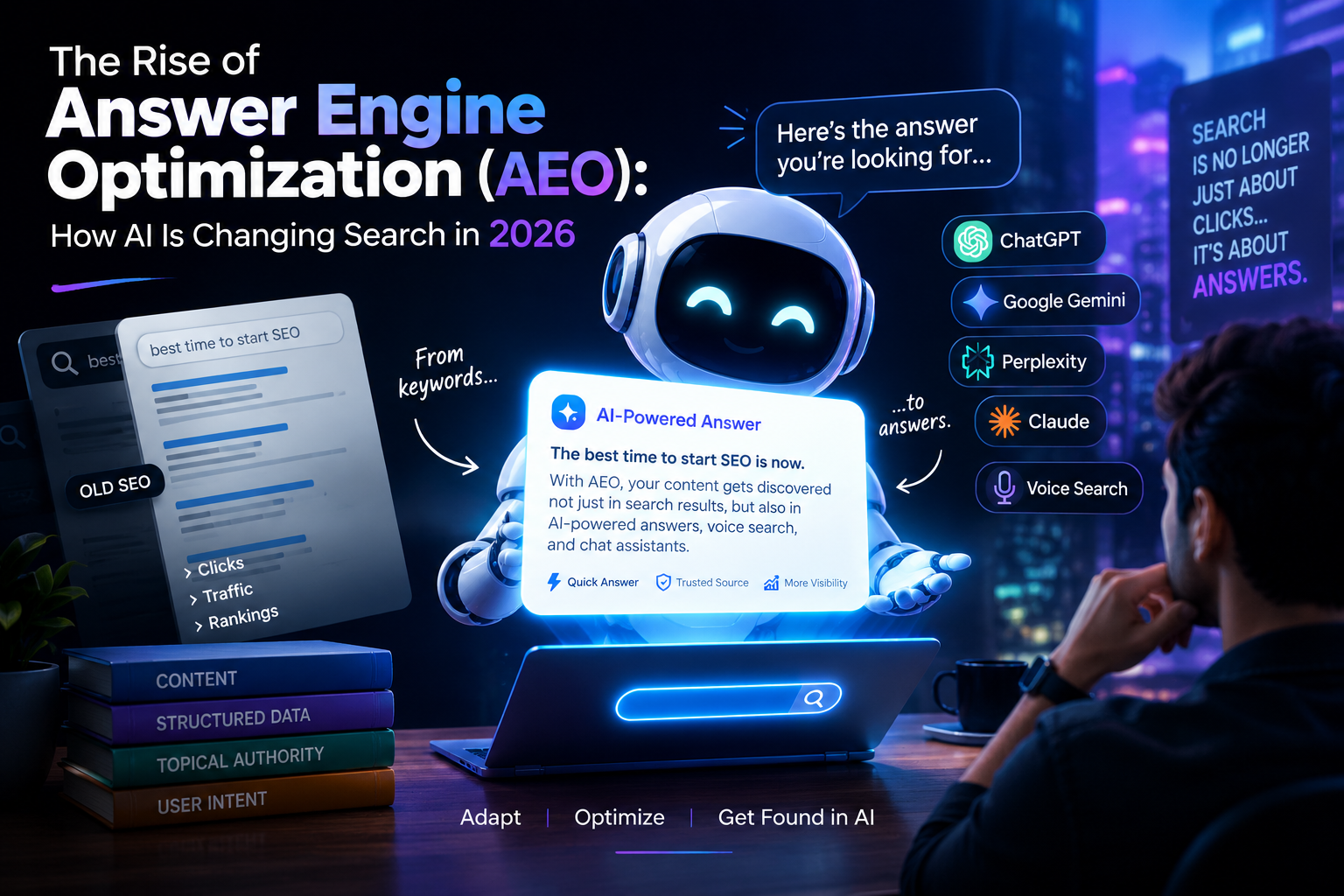


The Rise of Answer Engine Optimization (AEO): How AI Is Changing Search in 2026
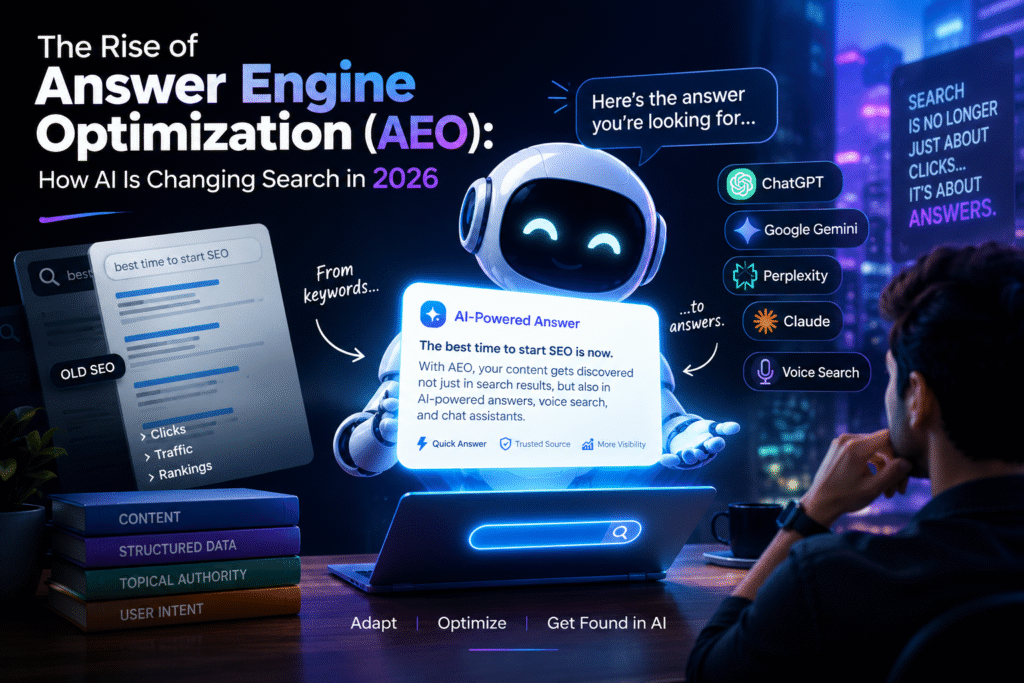
For years, the goal of SEO was simple: get your website onto page one of Google, then earn the click.
But what happens when the searcher stops scanning ten blue links and instead asks ChatGPT, Gemini, Perplexity, or Google’s own AI-generated search results for the answer directly? What happens when the “result” is a paragraph, not a page — and the user’s decision is already half-made before a single website loads?
That shift is no longer hypothetical. It’s measurable. Google’s AI Overviews now reach over 2.5 billion monthly active users, and its more conversational AI Mode has passed 1 billion monthly users, according to Google’s own June 2026 announcement.<sup>[1]</sup> Independent clickstream research from SparkToro and Similarweb found that 68.01% of U.S. Google searches ended without any click to any website in the first four months of 2026, up from 60.45% in 2024 — meaning that for every 1,000 searches, only about 276 clicks now reach the open web, down from roughly 374 two years earlier.<sup>[2]</sup> Separately, OpenAI’s ChatGPT is processing an estimated 2.5 billion messages a day across 800–900 million weekly active users in early-to-mid 2026.<sup>[3]</sup>
Search behavior is moving along a new path:
Old pattern: Query → Links → Click → Website Emerging pattern: Question → AI Answer → Sources/Recommendations → Decision
This doesn’t mean the first pattern has disappeared — most search traffic in most industries still runs through it. But a growing share of information journeys now resolve, at least partially, inside an AI-generated answer before (or instead of) a website visit. That creates a genuinely new visibility challenge: a business can rank #1 organically and still be functionally invisible if an AI answer synthesizes information from other sources, or if the user never scrolls past the answer box at all.
This guide explains what Answer Engine Optimization (AEO) actually is, how it relates to SEO and the newer term GEO (Generative Engine Optimization), what the research does and does not show, and what a business can realistically do about it in 2026 — without pretending AEO is a guaranteed traffic, lead, or revenue channel, because right now, it isn’t one.
What Is Answer Engine Optimization (AEO)?
Simple definition: AEO is the practice of structuring, writing, and distributing information so that AI systems — search engines with generative features, chatbots, and voice assistants — can find it, understand it, trust it, and use it when constructing an answer to a user’s question.
Advanced definition: AEO is a cross-disciplinary practice that combines structured content design, entity and brand consistency across the web, technical accessibility for machine parsing, third-party authority signals, and continuous multi-platform monitoring, with the goal of increasing the probability that a brand’s information is retrieved, cited, or recommended inside AI-generated answers — while acknowledging that no current technique guarantees inclusion, because retrieval and generation in these systems involve non-deterministic, frequently-updated, and largely opaque ranking processes.
Several elements matter more in this environment than in classic keyword-ranking SEO:
- Citations — being one of the sources an AI answer references or links to.
- Mentions — being named or described inside a generated answer even without a clickable citation.
- Entity understanding — whether the AI system has a clear, consistent model of who/what your brand is, what it does, and how it relates to other entities (founders, products, competitors, locations).
- Structured information — content organized so a system can isolate a direct answer rather than infer one from paragraphs of narrative prose.
- Authority and trust — signals (reviews, expert authorship, citations from other reputable sources, consistent facts across the web) that make a system more willing to rely on your content.
- Contextual relevance — how well content matches the actual nuance of a conversational question, not just a head-term keyword.
A concrete comparison
Traditional search
User: “Best CRM software for small businesses” Google: → a ranked list of ten website links the user must evaluate themselves.
AEO-relevant environment
User: “What CRM should a 10-person startup use if it needs WhatsApp integration and affordable automation?” AI system: → interprets the multi-part intent → retrieves and weighs several sources → synthesizes a direct answer → may name specific products → may cite two or three sources → the user may make a decision without visiting ten (or any) websites.
The practical implication: your information can influence a decision even when no click occurs, but you also have far less control over how it’s represented, and no reliable way to guarantee it’s represented at all.
What Is an Answer Engine?
Not every AI-powered surface works the same way, and treating them as interchangeable is a common mistake. Some are retrieval-heavy search engines with a generative layer bolted on top; others are general-purpose assistants that only sometimes search the live web.
| Platform Type | How Users Search | How Results Are Presented | Role of Websites | Role of Citations | User Journey | Example Platforms |
| Traditional search engine | Keyword or short phrase | Ranked list of links (10 blue links) | Central — the destination | Not applicable | Query → click → site | Classic Google/Bing organic results |
| Search engine with AI Overview/AI Mode | Keyword, question, or multi-part query | AI-generated summary above or alongside links, with expandable sources | Still central — Google explicitly designs these features to link out | High — sources are visibly linked | Query → AI summary → optional click | Google AI Overviews, Google AI Mode |
| Conversational AI assistant with live search | Natural-language question, often multi-turn | Conversational paragraph, sometimes with citations, sometimes without | Secondary — used as source material, not a required destination | Variable — depends on whether “search/browse” mode is active | Question → answer → optional follow-up → optional click | ChatGPT (with browsing), Perplexity, Microsoft Copilot |
| AI assistant without active browsing | Natural-language question | Answer generated from the model’s trained knowledge | Minimal at the moment of the answer — websites shaped the training data, not the live response | None in that mode | Question → answer, no live citation | ChatGPT/Gemini/Claude in a non-search default mode |
| Generative “answer engine” (dedicated) | Natural-language question | Synthesized answer with inline citations by design | Central, but curated by the system’s own retrieval logic | High — citation is often the core product feature | Question → cited answer → click-through to verify | Perplexity |
Two important caveats: platforms update their retrieval and citation behavior frequently, and even Google’s own AI features (AI Overviews vs. AI Mode) behave differently from each other. Nothing here should be read as a permanent architecture diagram.
Why Is AEO Rising?
| Trend | What Changed | Why It Matters | AEO Impact | Business Impact |
| Conversational search | Queries are becoming longer, more natural-language, more question-shaped | Systems must interpret intent, not just match keywords | Content needs to answer the actual question, not just target a phrase | Keyword lists alone under-represent real demand |
| Zero-click search | A growing share of searches end without any website click | Traffic is not a reliable universal proxy for visibility anymore | Being cited/mentioned matters even without a click | Traffic-only dashboards can misrepresent real performance |
| AI-assisted research | Users increasingly use AI tools mid-research, not just at the start | Brands can be evaluated and compared without a site visit | Comparison-ready, fact-dense content becomes more valuable | Consideration-stage visibility can happen off-site |
| Voice and assistant search | Growth in spoken, single-answer queries | There’s often room for only one spoken answer, not ten links | Direct, concise, well-structured answers are favored | Winner-take-most dynamic for some query types |
| Personalized/agentic search | Assistants increasingly act on the user’s behalf (compare, filter, book) | The “user” reading your content may increasingly be software | Structured data and clear specs matter for machine readability | Requires thinking beyond human-only content design |
| Search fragmentation | Discovery spread across Google, ChatGPT, Perplexity, Reddit, YouTube, TikTok | No single “search rank” tells the whole visibility story | Multi-platform monitoring becomes necessary | Measurement complexity increases |
| Multi-step / comparison queries | Users chain follow-up questions in one session | A single page must often support several related sub-questions | Content needs breadth as well as depth | Topical authority becomes more valuable than single-page optimization |
Important nuance: Some of the underlying behavioral drivers (conversational search, comparison research, voice queries) are well-documented industry observations from firms like Google, Semrush, and Pew Research. Others — like exactly how much buying behavior is influenced by AI tools versus merely touched by them — are still being actively studied, and current numbers vary widely between sources.
SEO vs. AEO
| Factor | Traditional SEO | AEO | Overlap | New AEO Consideration |
| Primary objective | Rank in the top organic results | Be retrieved, cited, or mentioned in an AI-generated answer | Both want relevant visibility for real user intent | Success can occur with zero click-through |
| Search behavior | Keyword-driven queries | Natural-language questions | Both respond to genuine intent | Longer, more conversational phrasing |
| Content structure | Optimized headings, keyword density, internal links | Direct-answer paragraphs, clear Q&A structure, extractable facts | Clear structure helps both | Front-loaded, self-contained answers |
| Measurement | Rankings, impressions, clicks, organic traffic | Citation frequency, brand mentions, AI referral traffic (where trackable) | Both use analytics tools | Metrics are still immature and largely proxy-based |
| Backlinks | Core ranking signal | One of several trust/authority signals feeding entity understanding | Both value earned authority | Off-site mentions (even unlinked) can matter |
| Featured snippets / AI Overviews | A visibility bonus on top of ranking | A related but distinct surface with its own selection logic | Both reward clear, well-structured direct answers | AI Overview inclusion doesn’t require a #1 ranking, though Google’s own data shows a correlation |
| Conversion / attribution | Reasonably traceable via UTM, referrer data | Frequently untraceable — many AI tools don’t pass clean referrer data | Both ultimately aim at business outcomes | Attribution gaps are a known, unresolved limitation |
| Technical SEO | Crawlability, indexability, speed, mobile usability | Same technical needs — if a page can’t be crawled or rendered, it can’t be cited | Fully shared foundation | No separate “AI crawler” tech stack is required per Google’s guidance |
Google’s own May 2026 update to its site-owner documentation is explicit on this point: it states that AEO and GEO tactics are, in Google’s words, “still SEO” — meaning the same fundamentals (helpful content, technical accessibility, demonstrated expertise) apply, and Google’s guidance explicitly pushes back on the idea that a separate ranking system requires separate hacks.<sup>[4]</sup> That’s Google’s official position for its own AI features; it doesn’t necessarily describe how every other AI platform behaves.
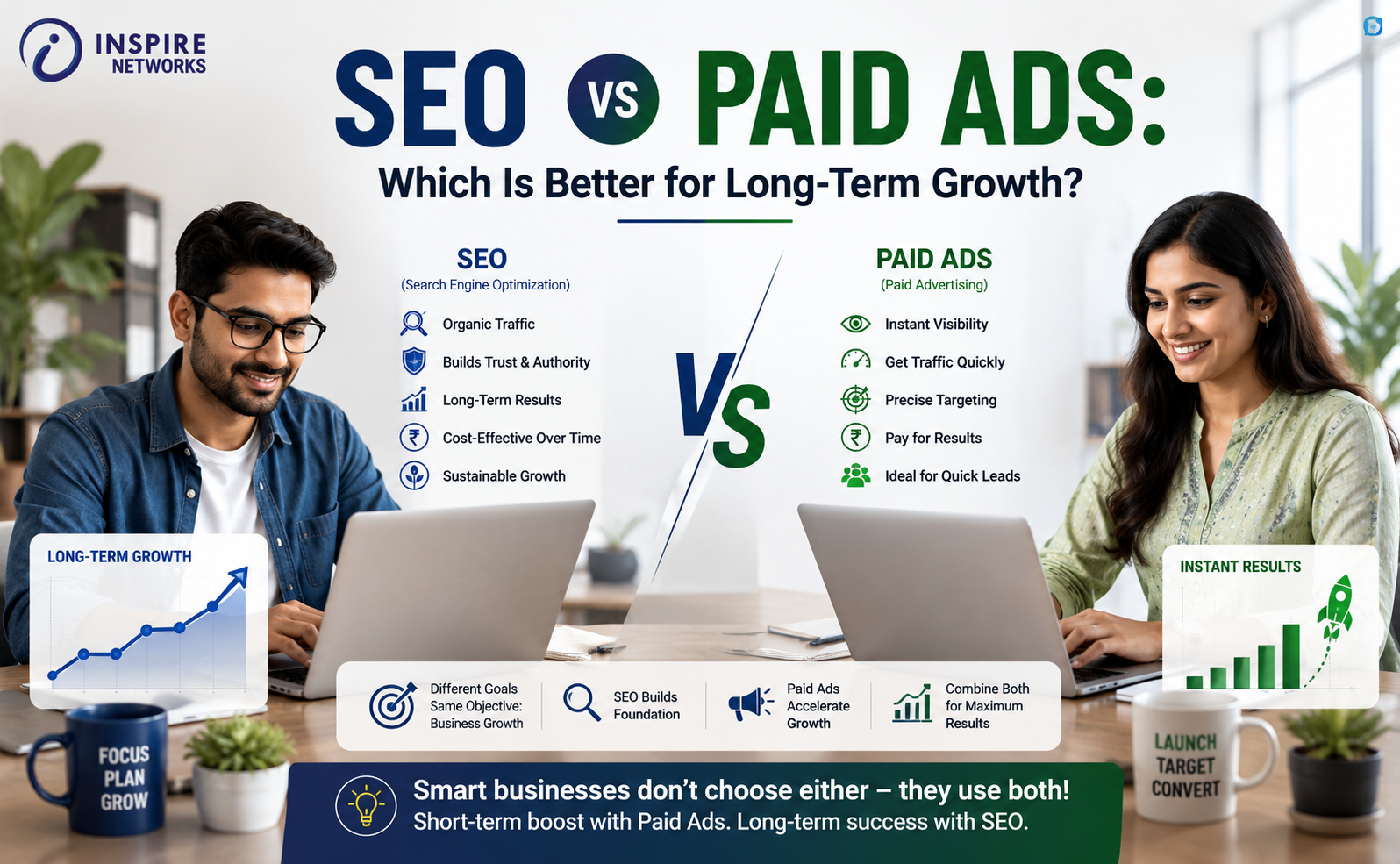
Neither channel is universally “better.” SEO still drives the majority of measurable, attributable web traffic for most businesses today. AEO expands the scope of optimization into surfaces where no click may ever occur — which matters for brand consideration, but is harder to prove out financially.
The SEO → AEO Evolution
Search hasn’t been replaced overnight; it’s layered:
Keyword-matching Search
↓
Semantic Search (understanding meaning, not just terms)
↓
Featured Snippets (direct-answer boxes)
↓
Voice Search (single spoken answers)
↓
AI-Generated Search (AI Overviews, AI Mode)
↓
Answer Engine Optimization (optimizing for citation/mention across all of the above, plus standalone AI assistants)
And the underlying unit of optimization has evolved too:
Keywords → Questions → Context → Entities → Answers → Recommendations
Each layer didn’t retire the one before it — Google still runs classic organic results underneath its AI features, and keyword research still informs question research.
AEO vs. GEO vs. SEO
The term Generative Engine Optimization (GEO) predates much of today’s “AEO” marketing language. It comes from a specific academic paper — “GEO: Generative Engine Optimization” by Aggarwal, Murahari, Rajpurohit, Kalyan, Narasimhan, and Deshpande, affiliated with Princeton University, the Allen Institute for AI, Georgia Tech, and IIT Delhi, first posted to arXiv in November 2023 and published at the ACM SIGKDD conference in 2024.<sup>[5]</sup> The paper introduced a benchmark (GEO-BENCH) testing roughly 10,000 queries across nine domains, and tested nine content-modification strategies. Its headline finding — often summarized as “GEO can boost visibility by up to 40%” — is a maximum relative improvement on a specific metric (Position-Adjusted Word Count) achieved by the top-performing tactics under controlled conditions, not a typical or guaranteed result for any given business.<sup>[6]</sup> Notably, later analysis of the paper found that adding citations from authoritative sources and adding relevant statistics were among the strongest levers, while keyword stuffing and pure “fluency” optimization showed almost no measurable benefit.<sup>[7]</sup>
| SEO | AEO | GEO | |
| Definition | Optimizing for ranking in traditional search results | Optimizing to be retrieved/cited/mentioned in direct-answer and assistant environments | Academic/technical term for optimizing content specifically for generative-AI response systems |
| Main objective | Higher rankings, more organic clicks | Inclusion in AI-generated answers, brand mentions | Measurable visibility lift inside a generative engine’s synthesized output |
| Primary environment | Search engine results pages | AI Overviews, AI Mode, chat assistants, voice search | Any LLM-based retrieval-and-generation pipeline |
| Content format | Ranking-optimized pages, backlink profiles | Direct-answer structured content, FAQs, entity clarity | Content engineered around retrieval/synthesis mechanics (citations, statistics, quotations) |
| Measurement | Rankings, CTR, organic sessions | Citation frequency, AI mentions, referral traffic (partial) | Position-Adjusted Word Count and similar experimental metrics (mostly research-only) |
| Main challenge | Competitive rankings, algorithm changes | No standardized metrics, inconsistent citation behavior | Findings are domain-specific and don’t generalize evenly |
Important honesty point: these terms are not standardized across the industry. Some vendors use “AEO” and “GEO” interchangeably; some reserve “GEO” for the academic/technical sense above and “AEO” for the more practitioner-facing marketing discipline. Treat vendor claims about a single, agreed-upon definition with skepticism.
How AEO Works (Simplified Conceptual Model)
User asks a question
↓
AI interprets the intent (including implied sub-questions)
↓
System retrieves candidate information (indexed pages, a knowledge base, or live search results)
↓
System evaluates sources for relevance, authority, and freshness
↓
System synthesizes an answer, sometimes blending multiple sources
↓
System may cite or link specific sources
↓
User reads the answer and decides: accept it, click through, or ask a follow-up
This is a simplified conceptual model, not a technical architecture diagram of any specific system. Google, OpenAI, Anthropic, Perplexity, and Microsoft each use different, partly undisclosed retrieval and ranking mechanisms, and those mechanisms change over time. Google’s public documentation does confirm that its AI features rely on retrieval-augmented generation (RAG) — grounding generated answers in its search index to improve accuracy and freshness — but declines to publish the specific ranking formula, just as it does for classic organic search.<sup>[8]</sup>
What Content Does AEO Favor?
Content that tends to be easier for these systems to parse, trust, and extract shares several traits:
- Direct, unambiguous answers stated early (often in the first sentence or two of a section)
- Question-phrased headings that mirror how people actually ask
- Concise, self-contained answer paragraphs (roughly 40–60 words is a commonly cited practical target among practitioners, though this is a heuristic, not a rule enforced by any platform)
- Lists, tables, and comparison structures
- FAQs addressing genuine follow-up questions
- Original data, statistics, and first-hand experience
- Visible author expertise and credentials
- Clear, consistent entity relationships (who you are, what you make, where you operate)
- Regularly updated information with visible freshness signals
- External references that support claims
- Consistent brand facts across your own site and third-party sources
The mindset shift that matters most: writing for keywords optimizes for matching a search term. Writing to comprehensively answer a real question optimizes for being useful enough that a human — or a system synthesizing an answer for a human — can lift the information cleanly and correctly.
Content Formats for AEO
| Content Format | Why It Can Help | AEO Opportunity | SEO Opportunity |
| FAQ pages | Directly mirrors question-based queries | High — natural Q&A extraction | Moderate — can support featured snippets |
| How-to guides | Step-based structure is easy to extract | High for process-related queries | High — long-standing SEO format |
| Comparison articles | Matches “X vs. Y” and “best for [need]” queries | High — comparison queries are common in AI search | High — commercial-intent traffic |
| Definition/glossary pages | Provides the “direct answer” AI systems favor for “what is X” | High for definitional queries | Moderate |
| Original research/statistics pages | Provides citable, unique data | High — original data is a strong citation magnet | High — earns backlinks |
| Case studies | Demonstrates real-world outcomes and credibility | Moderate — supports trust signals | Moderate |
| Product/service/pricing pages | Answers direct commercial questions | Moderate to high, depending on structure | High |
| Local business pages | Answers “near me” and local comparison questions | Moderate — depends heavily on off-page signals too | High — core local SEO asset |
| “Best tools/best X” articles | Matches recommendation-style queries directly | High | High |
| Problem/solution content | Matches troubleshooting and decision-support queries | High | Moderate to high |
AEO Keyword and Question Research
Traditional keyword research (search volume, difficulty, CPC) still matters, but it under-represents how people phrase questions to conversational systems.
Traditional keyword: CRM software Conversational question: What is the best CRM for a 10-person company that needs WhatsApp automation?
| Query Type | Example | Intent | Traditional SEO Value | AEO Value | Best Content Format |
| Head keyword | “CRM software” | Broad informational/commercial | High volume, high competition | Low direct value alone | Category/pillar page |
| Long-tail keyword | “CRM software for 10 person startup” | Narrower commercial | Moderate volume | Moderate–high | Comparison/buyer’s guide |
| Conversational question | “What CRM should a small team use for WhatsApp automation?” | Specific decision-support | Often unmeasurable in classic keyword tools | High | Direct-answer FAQ/guide section |
| Comparison query | “HubSpot vs Zoho CRM for small business” | Evaluation | Moderate | High | Comparison table/article |
| Follow-up query | “Does that CRM integrate with WhatsApp Business API?” | Clarifying/decision | Rarely tracked at all | High if answered directly | FAQ, feature page |
Because many conversational queries never appear in keyword-volume tools, question research increasingly draws on: actual customer questions (sales, support tickets), “People Also Ask” data, community discussions (Reddit, forums), and direct testing of prompts across AI platforms — an emerging but non-standardized practice.
AEO Search Intent Framework
| Intent | What the User Wants | Example Query | Best Content Type | AEO Opportunity | Conversion Potential |
| Informational | Learn a concept | “What is answer engine optimization?” | Definition/pillar page | High | Low (top-of-funnel) |
| Navigational | Find a specific brand/site | “HubSpot AEO tool” | Branded landing page | Low (already know the brand) | Variable |
| Commercial | Evaluate options | “Best CRM for startups” | Comparison/best-of article | High | Moderate |
| Transactional | Ready to act | “Buy CRM software monthly plan” | Pricing/product page | Moderate | High |
| Comparison | Choose between named options | “X vs Y” | Comparison table | High | Moderate–high |
| Recommendation | Wants a direct suggestion | “What should I use if I need Z?” | Buyer’s guide, expert recommendation content | High | Moderate–high |
| Problem-solving | Fix an issue | “Why is my CRM not syncing WhatsApp?” | Troubleshooting/how-to guide | High | Low–moderate |
| Local | Local option | “Coworking space near Vadapalani” | Local business/location page | Moderate (heavily off-page dependent) | High |
| Decision-support | Wants criteria before deciding | “What should I check before choosing a CRM?” | Checklist/guide content | High | Moderate |
Zero-Click Search
What it is: A search where the user gets their answer directly on the results page (or inside an AI assistant’s reply) without clicking through to any external website.
Why it matters: It changes what “visibility” means. A brand can be seen, referenced, or even recommended without generating a session in your analytics.
Independent data on this varies meaningfully by source, definition, and time period — which is itself worth understanding rather than glossing over:
- SparkToro and Similarweb’s clickstream research found the U.S. browser-based zero-click rate rose from 60.45% in 2024 to 68.01% in the first four months of 2026 — meaning roughly 276 of every 1,000 Google searches now result in a click to the open web, down from about 374 in 2024.<sup>[2]</sup>
- Pew Research Center found that users clicked through on just 8% of searches when an AI Overview was present in the results, compared with 15% when it was absent — a study widely cited by Similarweb and SparkToro in their 2026 analysis.<sup>[9]</sup>
- Semrush’s analysis of AI Overview prevalence across more than 10 million U.S. keywords found the feature’s appearance rate has fluctuated significantly — from roughly 6.5% of tracked queries in January 2025, peaking near 24.6% in July 2025, and settling around 15–16% by November 2025 — underscoring that AI Overview visibility is a moving target, not a fixed percentage.<sup>[10]</sup>
- Google itself does not publish a zero-click rate; it counts AI Overview and AI Mode appearances as part of “Web” search traffic in Search Console and states that clicks originating from AI Overviews tend to reflect higher engagement (more time on site) than average organic clicks, without providing the volume comparison needed to independently verify that claim.<sup>[11]</sup>
The honest limitation: zero-click visibility does not reliably translate into conversions, and no credible source claims it does. The realistic argument for caring about it is discovery, brand recall, and consideration-stage influence — not a replacement revenue channel.
Advantages of AEO
1. Greater visibility in AI-generated answers. Being one of the sources synthesized into an answer expands where your information can appear beyond the traditional results page. Limitation: visibility is inconsistent across platforms, queries, and time.
2. Potential brand mentions without a click. Even unlinked mentions can build familiarity. Limitation: mentions can be inaccurate or lack context, and you have limited ability to correct them.
3. Citation opportunities. A clickable citation inside an AI answer can function similarly to a high-intent referral link. Limitation: citation behavior differs by platform and isn’t guaranteed to persist.
4. Visibility during conversational research. Buyers researching multi-step decisions (e.g., “What CRM, and does it integrate with X?”) may encounter your brand mid-conversation. Limitation: hard to attribute or measure directly.
5. Potentially higher-intent visitors. Google states that traffic originating from AI Overview clicks shows higher engagement than average organic clicks.<sup>[11]</sup> Limitation: this is Google’s own reported observation, not independently audited, and doesn’t extend to other AI platforms.
6. Brand discovery before a website visit. A user may learn about your brand from an AI answer, then search for you directly later (a branded-search lift some practitioners report anecdotally). Limitation: difficult to prove causally with current analytics tools.
7. Better alignment with question-based search. Content built to directly answer real questions tends to also perform better in classic snippet and “People Also Ask” features. Limitation: alignment doesn’t guarantee inclusion in any specific feature.
8. Opportunity to build topical authority. Comprehensive, well-linked content clusters can support both AEO and SEO simultaneously. Limitation: this requires sustained investment, not a one-time optimization.
9. Support for voice and conversational search. Concise, direct-answer content is inherently better suited to being read aloud or summarized in a single reply. Limitation: voice search’s actual commercial impact remains under-researched relative to the attention it receives.
10. Potential influence at the comparison/consideration stage. Being named accurately in a “best X” or “X vs Y” AI answer may shape a shortlist. Limitation: being named is not the same as being chosen, and there is no reliable way to measure this influence directly today.
Disadvantages and Limitations of AEO
| Disadvantage | Why It Happens | Business Impact | Possible Mitigation |
| Difficult attribution | Many AI platforms don’t pass clean referrer/UTM data | Hard to prove ROI | Monitor branded search lift and direct traffic trends as imperfect proxies |
| Unpredictable AI responses | Generation is probabilistic; the same query can return different answers | Inconsistent visibility | Track over time and across multiple prompts, not a single snapshot |
| No guaranteed citation | Retrieval and synthesis logic is not published or fixed | Optimization can’t promise results | Set expectations as “improving odds,” not guaranteeing outcomes |
| No guaranteed traffic | Many answers resolve the user’s need without a click | Traffic-based reporting can understate real value | Add citation/mention tracking alongside traffic metrics |
| AI answers can change | Models and retrieval indexes update frequently | Yesterday’s inclusion doesn’t guarantee tomorrow’s | Treat AEO as ongoing monitoring, not a one-time project |
| Users may get different answers | Personalization, model version, and region can vary results | Hard to define a single “ranking” | Sample across regions/accounts when auditing visibility |
| Measurement is still developing | No industry-standard AEO analytics suite exists yet | Reporting requires combining multiple partial tools | Combine platform-native tools (e.g., Search Console) with third-party AI-visibility trackers, clearly labeling each as partial |
| AI referral volume can be small | AI-driven referral traffic remains a minority of total sessions for most sites today | Expectations need calibrating | Treat as an emerging channel, not a primary one, in near-term planning |
| Brand mentions can be inaccurate | Models can misstate facts, pricing, or features | Reputational/factual risk | Monitor mentions and correct authoritative source information where possible |
| Hallucination risk | Generative systems can produce plausible but false claims | Misinformation about your brand may circulate | Publish clear, structured, authoritative facts to reduce ambiguity |
| Competitor comparison is difficult | Answers may favor competitors for reasons that aren’t transparent | Uncertainty about competitive standing | Regularly test relevant prompts and document patterns over time |
| Tool and platform dependency | Being visible on one platform doesn’t transfer to another | Requires multi-platform effort | Prioritize platforms based on where your actual audience researches |
| Cost of ongoing monitoring | Multiple platforms, prompts, and time periods require sustained tracking | Resource-intensive for smaller teams | Start with a small, high-value prompt set rather than exhaustive tracking |
| Difficulty proving ROI | Combines attribution, hallucination, and measurement gaps above | Budget justification is harder than classic SEO/PPC | Frame investment around brand consideration and content quality gains that also serve SEO |
| Lack of standardized metrics | The industry hasn’t converged on shared AEO KPIs | Vendors define success differently | Treat vendor-reported metrics (e.g., “visibility score”) as proprietary and non-comparable across tools |
| Multi-touchpoint attribution | A decision may involve several AI and search touches before conversion | Single-touch attribution models undercount influence | Use multi-touch or assisted-conversion models where available, with clear caveats |
Merits vs. Demerits
| AEO Merits | AEO Demerits |
| Expands visibility beyond ranked links | No guaranteed citation or mention |
| Can build brand familiarity pre-click | Attribution is largely unreliable today |
| Rewards genuinely useful, well-structured content | Content can be cited without generating any traffic |
| Complements existing SEO investment | Requires monitoring across multiple, non-standardized platforms |
| Supports comparison/consideration-stage presence | AI-generated summaries of your brand can be inaccurate |
| Encourages clearer, more scannable writing | No industry-agreed KPI set exists yet |
| Can surface content to voice/assistant users | Small businesses may struggle to justify the monitoring cost |
| Original research/data gains extra leverage | Effects vary significantly by industry and query type |
| Structured data improves machine readability | Structured data does not guarantee inclusion |
| Strengthens overall entity/topical authority | Platforms change ranking/retrieval logic without notice |
AEO Risk Matrix
Likelihood and impact below are a practical, qualitative framework (Low/Medium/High) based on industry observation — not a statistically measured probability model.
| Risk | Likelihood | Potential Impact | Why It Happens | Mitigation |
| Incorrect AI representation of your brand | Medium | High | Model hallucination or outdated training data | Publish clear, consistent, structured facts; monitor and flag errors where feedback channels exist |
| Outdated information being cited | Medium | Medium | Content not refreshed; system indexed an old version | Maintain visible “last updated” dates and refresh key pages |
| Missing citations despite strong content | High | Medium | Retrieval logic favors other sources for undisclosed reasons | Diversify distribution (own site, third-party publications, directories) |
| Competitor over-representation | Medium | Medium | Competitor has stronger off-page signals or structured data | Benchmark competitor mentions periodically |
| Brand inconsistency across the web | Medium | Medium | Different facts/descriptions across your own properties and third parties | Standardize NAP (name/address/phone) and core facts everywhere |
| Low AI visibility overall | High for smaller/newer brands | Medium | Limited authority signals and content depth | Build topical authority incrementally; don’t expect fast results |
| Attribution failure | High | Medium | Referrer data stripped by many AI platforms | Use proxy metrics (branded search, direct traffic trend) with caveats |
| Over-optimization for AI at the expense of humans | Low–Medium | Medium | Writing exclusively in extractable fragments, sacrificing readability | Keep content genuinely useful to a human reader first |
| Dependence on a single AI platform | Medium | Medium–High | Concentrating effort on one assistant that changes its model or policy | Monitor and prioritize based on audience behavior, not just current buzz |
| Content becoming too generic | Medium | Medium | Chasing “extractability” formulas without original insight | Prioritize original data, first-hand expertise, and specificity |
Technical SEO and AEO
AEO does not replace technical SEO — it depends on it. If a system can’t crawl, render, or index your content, it can’t cite it. The fundamentals remain:
- Crawlability and indexability (robots directives, no accidental blocks)
- Clean, logical site architecture and internal linking
- Page speed and Core Web Vitals
- Mobile usability
- Structured data (schema markup)
- Correct canonical tags
- HTTPS
- Accurate, updated XML sitemaps
- Accessible, clean HTML (avoid burying key content only inside heavy client-side JavaScript without server-side rendering, since not all crawlers execute JavaScript equally well)
Google’s site-owner guidance explicitly states there are no additional technical requirements beyond standard SEO best practices to appear in its AI features — meaning the same crawlability and quality fundamentals that support classic organic ranking also underpin AI Overview and AI Mode inclusion.<sup>[12]</sup>
Structured Data
Structured data (schema.org markup) helps machines interpret what a page is about — but it does not guarantee an AI citation. It’s a clarity aid, not a ranking lever with a fixed payoff.
Commonly relevant types:
- Organization
- LocalBusiness
- Product
- Article
- FAQPage (where genuinely applicable to real on-page Q&A content)
- Review / AggregateRating
- BreadcrumbList
- Event
Use schema to accurately describe what already exists on the page. Markup that misrepresents content risks violating structured-data guidelines and can create trust issues, both with search engines and with AI systems trained partly on structured web data.
Entity SEO + AEO
An entity is a distinct, identifiable “thing” — a person, organization, product, or place — that a system can model and connect to other entities, rather than just a string of text.
Example entity chain: Brand → Founder → Product → Industry → Location → Services → Reviews → Publications mentioning the brand
Text-based entity ecosystem diagram:
Consistency across these nodes — the same name, description, founding facts, and claims repeated accurately across your own site and third-party sources — supports a clearer entity model, which in turn supports (without guaranteeing) more accurate AI representation.
Topical Authority
A single article rarely earns durable AI or search visibility on a competitive topic. Depth across a cluster tends to matter more.
Pillar Page (e.g., “Digital Marketing Agency Services Explained”)
↓
Cluster Pages (service-specific deep dives)
↓
Supporting Articles (how-to, comparison, definitional)
↓
FAQs (addressing real follow-up questions)
↓
Case Studies (proof and specificity)
↓
Original Research (unique, citable data)
↓
Internal Links (connecting all of the above into one coherent structure)
Example — 15–18 supporting topics for a “Digital Marketing Agency” pillar:
- What does a digital marketing agency do?
- SEO vs. PPC: which should a small business start with?
- How much does a digital marketing agency cost?
- In-house team vs. agency vs. freelancer
- How to choose a digital marketing agency (checklist)
- Digital marketing agency vs. marketing consultant
- What is included in a typical retainer?
- Social media marketing services explained
- Content marketing services explained
- Email marketing services explained
- Case study: a client campaign result (anonymized or real, with permission)
- Common digital marketing mistakes small businesses make
- How to measure marketing ROI
- What questions to ask before signing an agency contract
- Digital marketing agency for e-commerce vs. local business
- AEO/GEO services: what they are and aren’t
- Marketing automation tools comparison
- How long before digital marketing “works”?
AEO Content Structure Template
H1 (matches the core question/topic)
Direct answer (1–3 sentences, stated plainly, no throat-clearing)
Context/expansion (why, background, nuance)
H2 (a real sub-question)
Direct answer
Explanation
Example
Supporting data/table
FAQ section (genuine follow-up questions)
Sources/references
Author information and credentials
This structure may improve clarity and machine extractability — it does not guarantee inclusion in any specific AI answer or ranking position.
AEO Writing Formula
Question
↓
Direct Answer (stated immediately)
↓
Explanation (the “why” behind the answer)
↓
Evidence (data, source, or reasoning)
↓
Example (a concrete illustration)
↓
Action (what the reader should do with this information)
↓
Related Questions (natural follow-ups, ideally answered nearby)
AEO Metrics
| Metric | SEO | AEO | What It Measures | Measurement Difficulty |
| Rankings | Core metric | Loosely related (AI Overview inclusion correlates with, but isn’t identical to, top rankings) | Position in results | Low (SEO) / Medium (AEO correlation) |
| Impressions | Core metric (Search Console) | Partially visible (Search Console reports AI feature impressions as part of “Web” traffic) | How often shown | Low–Medium |
| Clicks / CTR | Core metric | Often unavailable or reduced | Click-through behavior | Low (SEO) / High (AEO) |
| Organic traffic | Core metric | A shrinking share of total discovery for informational queries | Sessions from search | Low (SEO) / Medium (AEO, due to attribution gaps) |
| AI mentions | N/A | Emerging metric | How often/accurately a brand is named in AI answers | High — requires manual or third-party prompt testing |
| AI citations | N/A | Emerging metric | Whether a specific page is linked/referenced in an AI answer | High |
| Brand inclusion rate | N/A | Emerging metric | Share of relevant prompts where your brand appears at all | High |
| AI referral traffic | N/A | Emerging, partial | Sessions arriving via AI platform referrer (where trackable) | Medium–High |
| Branded search lift | Established proxy | Established proxy | Increase in direct brand-name searches, possibly following AI exposure | Medium (causality is hard to isolate) |
| Conversion rate | Core metric | Core metric, when traceable | Visits that complete a goal | Low (SEO) / High (AEO) |
| Revenue influenced by AI discovery | N/A | Largely unmeasured today | Business impact attributable to AI-driven awareness | Very high — no reliable industry method yet |
Direct vs. proxy metrics: rankings, impressions, and clicks are direct SEO metrics with mature tooling. Most AEO metrics above are proxy metrics — reasonable but imperfect stand-ins for something that can’t yet be measured cleanly.
AEO Measurement Framework
Visibility → Engagement → Traffic → Leads → Conversions → Revenue
- Visibility: brand mentions across AI platforms, citation frequency, share of voice against named competitors on relevant prompts
- Engagement: time-on-page for AI-referred sessions (where trackable), scroll depth, return visits
- Traffic: AI referral traffic (where platforms pass it), branded search volume trend, direct traffic trend
- Leads: form fills, demo requests, newsletter signups from any traceable AI-influenced session
- Conversions: purchases, signups, booked calls
- Revenue: attributed and assisted revenue, acknowledging that full attribution is not currently achievable
AEO ROI
A conceptual formula some practitioners use:
AEO ROI = (Attributed Revenue − AEO Investment) / AEO Investment × 100
This formula is only as good as the “Attributed Revenue” figure feeding it — and that figure is currently unreliable for most businesses, because:
- Direct attribution (a session traced to a specific AI citation) is rare, since most AI platforms don’t pass clean referrer data.
- Assisted attribution (a touch that contributed to, but didn’t close, a conversion) requires multi-touch tracking most small and mid-sized businesses don’t have configured for AI sources specifically.
- Influenced revenue (a broader, softer claim — “this customer mentioned finding us via ChatGPT”) relies on self-reported, unverifiable customer statements.
- Multi-touch attribution models exist in enterprise marketing stacks but are rarely configured to isolate AI-platform touches distinctly from organic search touches today.
Honest conclusion: treat any AEO ROI figure — your own or a vendor’s — as a directional estimate built on incomplete data, not an audited financial return.
SEO vs. AEO: The Same Topic, Written Two Ways
Topic: “Best CRM for Small Business”
Version 1 — Traditional SEO-oriented:
“Choosing the right CRM software is one of the most important decisions a small business can make. In this comprehensive guide, we’ll explore the top CRM software for small business owners in 2026, covering features, pricing, and more to help you make the best CRM software decision for your small business needs.”
Version 2 — AEO-oriented:
“For a 10-person startup that needs WhatsApp integration and affordable automation, the strongest options are typically CRMs with native WhatsApp Business API support and usage-based pricing rather than flat per-seat fees. Below, we compare three options against that specific need.”
Version 2 works better in an AI-answer context because it: answers a specific, real question immediately; avoids repetitive keyword phrasing that adds no informational value; and gives the system (or the human reader) a fact-dense sentence that can be extracted or paraphrased cleanly. Version 1 isn’t “wrong” for classic SEO — it can still rank — but it delays the actual answer and repeats the target phrase in a way that reads as filler.
Practical Example: A Fictional Chennai Coworking Space
(Illustrative only — no real business is being recommended or referenced.)
| Question | Search Intent | Content Needed | Possible AEO Opportunity | Conversion Action |
| “What is the best coworking space in Chennai for a startup?” | Recommendation | Comparison/best-of page with clear criteria | High — recommendation queries are common in AI search | Book a tour CTA |
| “Affordable coworking space in Vadapalani?” | Local + budget-conscious | Location-specific page with pricing | Moderate — heavily dependent on local/off-page signals | Contact form |
| “Best private office for a small team in Chennai?” | Commercial, specific need | Product/service page describing private office tiers | Moderate–high | Request quote |
| “What should I check before choosing a coworking space?” | Decision-support | Checklist/guide article | High — matches decision-support intent well | Newsletter signup / soft CTA |
| “How much does coworking cost in Chennai?” | Informational/commercial | Transparent pricing page or guide | High — direct-answer pricing content is highly extractable | Pricing page CTA |
Local AEO
Local visibility depends on multiple, interacting signals — no single tactic guarantees inclusion in a local AI answer or map result:
- Google Business Profile completeness and accuracy
- Review volume, recency, and sentiment
- NAP (name, address, phone) consistency across the web
- LocalBusiness structured data
- Location-specific content (not just a generic page with a city name swapped in)
- Third-party local directory listings and mentions
- Genuine local content (neighborhood guides, local case studies)
AEO for Different Business Types
| Business Type | Common AI Queries | Best Content | AEO Opportunity | Key Trust Signals | Conversion Goal |
| SaaS | “Best tool for [use case]”, “X vs Y” | Comparison pages, integration docs | High | Reviews (G2, Capterra), case studies | Trial signup |
| E-commerce | “Best [product] under $X”, “is [brand] worth it” | Buying guides, spec comparisons | High | Reviews, return policy clarity | Purchase |
| Real estate | “Best area to buy in [city]”, “cost of living in X” | Neighborhood guides, market data | Moderate | Licensing, local expertise | Inquiry/lead form |
| Healthcare | “Symptoms of X”, “when to see a doctor for Y” | Medically reviewed content | High visibility, high scrutiny | Clinical credentials, citations | Appointment booking |
| Education | “Best course for X”, “is [certification] worth it” | Curriculum breakdowns, outcome data | High | Accreditation, alumni outcomes | Enrollment inquiry |
| Restaurants | “Best [cuisine] near me” | Menu, location, review-rich pages | Moderate — local-signal dependent | Reviews, photos | Reservation/order |
| Coworking | “Best coworking space for X” | Comparison/pricing pages | Moderate–high | Reviews, tour availability | Tour booking |
| Digital marketing agencies | “Best agency for X industry” | Case studies, service breakdowns | High | Case studies, client results | Consultation booking |
| Professional services (legal, accounting) | “Do I need a lawyer for X”, “how much does X cost” | Explainer + pricing transparency content | High | Credentials, disclaimers | Consultation request |
| Local businesses (general) | “Best [service] near me” | Local landing pages | Moderate — highly off-page dependent | Reviews, NAP consistency | Call/visit |
AEO Across Funnel Stages
| Funnel Stage | Typical Question | Content Type | AEO Opportunity | CTA |
| Awareness | “What is [category/problem]?” | Definitional/educational content | High | Soft (newsletter, related content) |
| Consideration | “What are my options for X?” | Comparison/buyer’s guide | High | Guide download, comparison tool |
| Evaluation | “X vs Y, which is better for [need]?” | Detailed comparison, reviews | High | Demo/trial |
| Decision | “How much does X cost / how do I buy it?” | Pricing, FAQ, checkout support content | Moderate–high | Purchase/signup |
| Retention | “How do I use feature X?” / “Troubleshoot Y” | Help center, tutorials | Moderate | In-product engagement, upsell content |
Off-Page AEO
AEO is not only about your own website. AI systems draw on a broader information ecosystem:
- Reviews (Google, G2, Capterra, Trustpilot, industry-specific platforms)
- Reddit and forum discussions
- Industry publications and press coverage
- News articles
- Third-party comparison and “best of” sites
- YouTube content and transcripts
- Expert quotes and interviews
- Digital PR placements
- Business directories
- Community discussions and Q&A platforms (e.g., Quora)
No platform’s influence on any specific AI system’s output can be guaranteed or measured with precision — this is a matter of accumulating credible, consistent third-party signal over time, not a checklist with predictable payoffs.
AEO and Social/Fragmented Search
Discovery is increasingly spread across surfaces that don’t behave like traditional search at all:
| Platform | Discovery Style | AI-Search Relevance |
| Query-based, increasingly AI-augmented | Direct (AI Overviews, AI Mode) | |
| YouTube | Video search, often used for how-to/reviews | Indirect — transcripts may feed AI training/retrieval |
| Community discussion, often surfaced in Google results and cited by AI tools | Increasingly direct — several AI systems visibly cite Reddit threads | |
| Professional content, B2B discovery | Indirect | |
| Instagram/TikTok | Visual/short-form discovery, especially for younger demographics | Largely indirect for text-based AI answers today |
| ChatGPT/Gemini/Perplexity | Conversational, question-based | Direct |
This fragmentation means a single “SEO ranking” no longer represents the full picture of discoverability.
Common AEO Mistakes
- Keyword stuffing carried over from old SEO habits
- Writing only for AI extractability and losing human readability
- Ignoring the human reader in favor of “the algorithm”
- Fabricating or exaggerating statistics
- Publishing generic, AI-generated content with no original insight
- Skipping original research or first-hand data entirely
- Omitting sources and citations
- No visible author credibility or expertise
- Letting content go stale without updates
- Poor structural organization (no clear headings, no direct answers)
- Ignoring technical SEO fundamentals
- Ignoring reviews and reputation management
- Ignoring third-party mentions and off-page signal
- Measuring success by website traffic alone
- Expecting fast, guaranteed results
- Focusing exclusively on one AI platform
- Assuming a citation or mention automatically equals a conversion
AEO Checklist
Technical
- [ ] Site is fully crawlable (no accidental robots.txt blocks)
- [ ] Key content is server-rendered or otherwise accessible to crawlers, not JavaScript-only
- [ ] Core Web Vitals and page speed meet current benchmarks
- [ ] Mobile usability verified
- [ ] HTTPS enabled sitewide
- [ ] XML sitemap current and submitted
Content
- [ ] Each key page states a direct answer early
- [ ] Question-based H2/H3 headings match real user questions
- [ ] FAQs address genuine follow-up questions, not filler
- [ ] Original data, statistics, or first-hand experience included where possible
- [ ] Content freshness/updated dates are visible
- [ ] Comparison and “best for [need]” content exists for key decision queries
Authority
- [ ] Author bios with real credentials are visible
- [ ] External sources and citations back up key claims
- [ ] Case studies or proof points are published
- [ ] Reviews are actively collected and monitored
Entity
- [ ] Brand name, description, and key facts are consistent across the site
- [ ] Consistent facts appear on third-party profiles (LinkedIn, directories, press)
- [ ] Organization/LocalBusiness schema is implemented and accurate
Off-page
- [ ] Business is listed and accurate on relevant directories
- [ ] Digital PR or expert-quote opportunities are pursued
- [ ] Reddit/forum/community presence is monitored (not necessarily controlled)
- [ ] Third-party comparison sites are checked for accuracy
Measurement
- [ ] Search Console is monitored for AI feature impressions where visible
- [ ] Branded search volume trend is tracked over time
- [ ] A defined set of relevant prompts is tested periodically across major AI platforms
- [ ] AI referral traffic (where trackable) is segmented in analytics
Conversion
- [ ] Pricing and key decision-support information is transparent and easy to extract
- [ ] Clear CTAs exist at multiple funnel stages
- [ ] Lead capture is in place for AI-referred and organic sessions alike
90-Day AEO Roadmap
Days 1–30 — Foundation and Audit
- Goals: Understand current state; fix baseline technical issues
- Tasks: Technical SEO audit, crawlability check, Core Web Vitals review
- Content: Identify top 10–15 pages with the highest potential for direct-answer restructuring
- Technical work: Fix any indexing/crawlability blockers; implement or audit existing schema
- Off-page work: Audit NAP consistency and current review profile
- Measurement: Establish a baseline set of 15–25 test prompts across 2–3 AI platforms; document current brand mentions (if any)
- Expected learning: A realistic picture of current visibility — likely low or inconsistent for most brands at this stage
Days 31–60 — Structural and Content Work
- Goals: Restructure priority content; begin closing content gaps
- Tasks: Rewrite priority pages using the AEO content structure template; add FAQs addressing real questions
- Content: Publish 3–5 new comparison, definitional, or original-research pieces
- Technical work: Expand structured data coverage; verify rendering for crawlers
- Off-page work: Pursue 2–3 digital PR or expert-quote opportunities; respond to/encourage reviews
- Measurement: Re-run the baseline prompt set; note any changes in mention frequency or accuracy
- Expected learning: Early signal on whether structural changes correlate with any visibility shift — not a proof of causation
Days 61–90 — Expansion and Monitoring Cadence
- Goals: Build topical depth; establish an ongoing monitoring rhythm
- Tasks: Expand supporting content around the pillar/cluster model; formalize a recurring AI-visibility check
- Content: Add case studies and update older content with fresh data
- Technical work: Address any remaining technical debt surfaced during the quarter
- Off-page work: Continue accumulating third-party mentions and reviews
- Measurement: Establish a repeatable monthly or quarterly reporting cadence combining SEO metrics, AI mention tracking, and branded search trends
- Expected learning: A clearer (though still incomplete) picture of whether AEO efforts are producing measurable movement, sufficient to plan the next quarter
No specific traffic, lead, or citation increase is promised at any stage. This roadmap describes a reasonable process, not a guaranteed outcome.
AEO Strategy for Small Businesses
- Start with existing content. Audit your best-performing pages and restructure them for direct answers before writing anything new.
- Avoid over-investing in expensive multi-platform monitoring tools before you have foundational content and technical SEO in order.
- Identify real questions from actual customer conversations — sales calls, support tickets, reviews — rather than guessing.
- Update, don’t just create. Refreshing five strong existing pages often beats publishing twenty new thin ones.
- Build authority incrementally through consistent, accurate information and genuine reviews rather than trying to “hack” visibility.
- Monitor manually at first — a spreadsheet of 10–15 prompts checked monthly is a reasonable starting point for a small business.
AEO Strategy for Enterprises
- Content library governance: audit large content libraries for consistency, freshness, and structural quality at scale.
- Multi-location and product-database complexity: ensure structured data accurately represents large, frequently changing catalogs.
- Entity management at scale: maintain a single source of truth for brand facts across many properties, subsidiaries, and regions.
- Digital PR and reputation management: invest in ongoing third-party coverage and review management across markets.
- Analytics and governance: establish clear ownership for AI-visibility monitoring, distinct from (but coordinated with) SEO and PR teams.
- Cross-platform monitoring infrastructure: larger budgets can support broader prompt-testing coverage across more AI platforms and regions.
The Future of AEO
| Current Reality (2026) | Emerging Trend | Possible Future (Speculative) |
| AI Overviews and AI Mode reach billions of monthly users at Google alone | Growth in “agentic” AI that acts on a user’s behalf (comparing, filtering, even booking) | AI agents completing multi-step purchasing decisions with minimal human review |
| ChatGPT and Perplexity offer live browsing/citation in some modes | Increased blending of chat assistants with real-time search | A convergence where “search” and “assistant” become largely indistinguishable products |
| Zero-click behavior is rising but not universal across query types | Personalized, context-aware answers based on prior conversation history | Search results that differ meaningfully per user, complicating the idea of a single “ranking” |
| Attribution tooling for AI-driven traffic is immature | Emerging third-party AI-visibility monitoring platforms | Industry-standard AEO metrics and reporting frameworks |
| Google states no special optimization is required beyond SEO fundamentals | Continued platform experimentation with citation formats and preferred-source controls | More formal mechanisms for site owners to influence how they’re represented in AI answers |
Treat the right-hand column as informed speculation, not a roadmap you should build a budget around today.
SEO + AEO: A Final Framework
SEO helps your content become discoverable. AEO helps your information become understandable, extractable, mentionable, and potentially citable in answer-driven environments.
Put together, the practical goal for 2026 is building content that achieves all of the following simultaneously:
Discoverability + Understandability + Authority + Trust + Citability + Conversion
None of these six replace the others. A page that’s perfectly structured for AI extraction but has no authority behind it is unlikely to be trusted. A page with enormous authority but poor structure may be hard for a system to extract cleanly. The work is cumulative, not either/or.
Frequently Asked Questions
1. What is AEO? Answer Engine Optimization is the practice of structuring and distributing content so AI systems — search engines with generative features, chat assistants, and voice tools — can find, understand, and potentially cite or mention it when answering a user’s question. It sits alongside, not in place of, traditional SEO.
2. What is the difference between AEO and SEO? SEO primarily optimizes for ranking in a list of links on a results page and earning a click. AEO optimizes for being retrieved, understood, and potentially cited or mentioned inside a synthesized AI answer, where a click may never occur. They share the same technical and content-quality foundation but differ in what “success” looks like and how it’s measured.
3. Is AEO replacing SEO? No. Classic organic search still drives the majority of measurable web traffic for most businesses today, and Google’s own documentation states that the same SEO fundamentals underpin its AI features. AEO expands optimization into new surfaces; it doesn’t retire the old ones.
4. What is an answer engine? Any system that returns a synthesized response instead of, or alongside, a list of links — including Google’s AI Overviews and AI Mode, ChatGPT, Gemini, Perplexity, and Microsoft Copilot. These platforms differ meaningfully in how they retrieve, cite, and present information.
5. How does AEO work? Conceptually: a user asks a question, the system interprets intent, retrieves candidate information, evaluates sources, synthesizes an answer, and may cite sources. The user then accepts the answer, clicks through, or asks a follow-up. This is a simplified model — actual system architectures are proprietary and vary by platform.
6. Does AEO increase website traffic? Not reliably or predictably. Many AI-answer interactions resolve the user’s need without any click. AEO’s more defensible value is in brand mentions, citation opportunities, and consideration-stage influence — not guaranteed traffic growth.
7. How do I optimize content for ChatGPT? There’s no official ChatGPT ranking algorithm to “optimize for” in the SEO sense. Practical steps include publishing clear, well-structured, factually consistent, and citable content; maintaining strong third-party presence (reviews, press, directories); and periodically testing how ChatGPT represents your brand across relevant prompts, since its browsing/citation behavior can vary by mode and update.
8. How do I optimize content for Google’s AI Overviews or AI Mode? Google’s own May 2026 documentation states there are no special requirements beyond standard SEO best practices — helpful, well-structured, technically accessible content with demonstrated expertise. Structured data and clear direct-answer formatting can support this, but neither is a documented ranking guarantee.
9. Does AEO require backlinks? Backlinks remain one signal contributing to overall site authority, which can indirectly support AI trust and citation likelihood, but no evidence shows backlinks function as a direct AEO ranking factor the way they historically have for organic SEO rankings.
10. What metrics should I track? A combination of established SEO metrics (rankings, organic traffic, conversions) alongside emerging, imperfect AEO proxies: AI mention frequency, citation frequency across a defined prompt set, branded search trend, and AI referral traffic where platforms provide it. Treat the AEO metrics as directional, not precise.
11. How long does AEO take? There’s no reliable published timeline, because the underlying systems change frequently and measurement is still immature. A realistic approach treats the first 90 days as foundation-building and baseline-setting, not a period in which specific results should be expected.
12. Can small businesses benefit from AEO? Yes, in the sense that restructuring existing content for direct answers, maintaining accurate local/business information, and collecting genuine reviews are low-cost activities that can plausibly support both SEO and AEO. No source supports a guarantee of proportionally larger or smaller benefit by business size.
13. What is GEO vs. AEO? GEO (Generative Engine Optimization) originated as an academic term from a 2023/2024 Princeton-affiliated research paper measuring content-optimization effects inside a controlled generative-search benchmark. AEO is the broader, more practitioner-facing term used across the marketing industry for the same general goal — visibility inside AI-generated answers. The two terms are not yet used consistently across the industry.
14. Is structured data important for AEO? It’s helpful for machine interpretation of your content, but it does not guarantee inclusion in an AI-generated answer. Think of it as reducing ambiguity, not as a ranking lever with a predictable payoff.
15. How do I measure AEO ROI? Conceptually, (Attributed Revenue − Investment) / Investment × 100 — but the “Attributed Revenue” input is currently unreliable for most businesses due to attribution gaps in AI referral data. Treat any AEO ROI figure as a directional estimate, not an audited number.
16. What content formats work best for AEO? FAQs, how-to guides, comparison articles, definitional/glossary content, original research, and case studies tend to perform well because they map closely to how people phrase questions to AI systems and because they contain clearly extractable, direct information.
17. Can AI cite my website? Yes — several AI platforms, including Google’s AI features and Perplexity, are designed to cite sources. But no platform guarantees citation for any specific page, and citation behavior can change between sessions, model updates, and regions.
18. What are the biggest AEO mistakes? Chasing “extractability” at the expense of human readability, fabricating statistics, publishing generic AI-written content with no original insight, ignoring technical SEO fundamentals, and assuming a citation or mention automatically converts into a lead or sale.
Advantage / Disadvantage Master Table
| Aspect | Potential Advantage | Potential Disadvantage | What Businesses Should Consider |
| Visibility | Appears in new AI-generated surfaces | No guarantee of appearance or persistence | Treat as expanded opportunity, not a reliable channel |
| Brand mentions | Builds familiarity pre-click | Can be inaccurate or out of context | Monitor regularly; correct where feasible |
| Citations | Functions like a high-intent referral | Citation behavior varies by platform/time | Diversify presence across platforms |
| Traffic | Some AI-referred clicks show higher engagement (Google’s own reported observation) | Majority of AI interactions may generate zero clicks | Don’t set traffic-growth KPIs solely around AEO |
| Attribution | Branded search lift can be a useful proxy | Direct attribution is largely unavailable | Use proxy metrics with clear caveats |
| Content quality | Rewards genuinely useful, well-structured writing | Risk of over-optimizing into generic “extractable” fragments | Prioritize human usefulness first |
| Technical requirements | Builds on existing SEO technical foundation | No separate technical “AI SEO” stack exists per Google’s guidance | Don’t over-invest in unproven technical hacks |
| Structured data | Improves machine interpretability | Doesn’t guarantee citation | Use accurately, not as a shortcut |
| Local visibility | Can support “near me” and local recommendation queries | Heavily dependent on off-page signals outside direct control | Maintain consistent NAP and reviews |
| Cost | Many tactics overlap with existing content/SEO work | Multi-platform monitoring can be resource-intensive | Start small; scale monitoring with resources |
| Measurement | Emerging tools provide partial visibility | No standardized industry metrics yet | Combine multiple partial signals, label them clearly |
| Competitive dynamics | Opportunity for smaller brands with strong niche content to be cited | Larger, more authoritative brands may be favored by retrieval systems | Focus on genuine expertise in a defined niche |
| Platform dependency | Diversifying reduces single-platform risk | Platforms differ enough that tactics don’t transfer cleanly | Prioritize based on where your actual audience is |
| Longevity | Well-structured content also supports long-term SEO value | AI ranking/retrieval logic can shift without notice | Treat as continuous work, not a one-time project |
| Business risk | Low direct risk from most best practices (they mirror good SEO/content hygiene) | Overclaiming AEO results to stakeholders creates credibility risk | Report conservatively and transparently |
Conclusion
The goal isn’t to choose between SEO and AEO.
The goal is to build content that:
- Can be discovered — by crawlers, indexes, and retrieval systems alike
- Can be understood — by both human readers and machine systems parsing your pages
- Can be trusted — through demonstrated expertise, consistency, and accurate facts
- Can be referenced — by other credible sources across the web
- Can be cited — when an AI system is assembling an answer
- Can influence a decision — at whichever stage a person or system encounters it
- Can convert — when the moment and the offer are actually right for it
SEO fundamentals — crawlability, technical health, genuine expertise, earned authority — and answer-oriented content design aren’t competing philosophies. They’re the same underlying discipline, applied to a search landscape that now includes both ranked links and generated answers. Businesses that keep investing in clear, honest, well-structured, genuinely useful content will likely be reasonably positioned for both — not because either channel is guaranteed to deliver a specific result, but because that’s what has always made content worth discovering in the first place.
SEO Metadata
- SEO Title: Answer Engine Optimization (AEO) in 2026: The Complete Guide to AI Search
- Meta Description: A deeply researched guide to Answer Engine Optimization (AEO) in 2026 — how it differs from SEO, how AI search works, and what businesses should actually do about it.
- URL Slug: /answer-engine-optimization-aeo-guide-2026
- Primary Keyword: Answer Engine Optimization (AEO)
- Secondary Keywords: AEO vs SEO, AI search optimization, GEO Generative Engine Optimization, AI Overviews optimization, zero-click search
- Long-tail Keywords: “how to optimize content for ChatGPT,” “what is answer engine optimization,” “AEO checklist for small business,” “AI search vs traditional SEO 2026”
- Search Intent: Informational (primary), Commercial (secondary — for readers evaluating whether to invest in AEO services)
- Suggested H1: The Rise of Answer Engine Optimization (AEO): How AI Is Changing Search in 2026
- Suggested H2s: What Is AEO? / What Is an Answer Engine? / SEO vs. AEO / AEO vs. GEO vs. SEO / How AEO Works / AEO Metrics / AEO Checklist / 90-Day AEO Roadmap / FAQs
- Suggested H3s: A concrete comparison / AEO Content Structure Template / AEO Writing Formula / AEO Strategy for Small Businesses / AEO Strategy for Enterprises
- Featured Snippet Opportunity: The “What Is AEO?” simple definition paragraph, and the “SEO → AEO Evolution” flow diagram
- FAQ Schema Opportunity: The full FAQ section (18 Q&As) is a strong candidate for FAQPage schema, provided the questions and answers remain unchanged from what’s displayed on-page
- Internal Linking Suggestions: Link to a dedicated glossary/definition page for “answer engine,” a separate deep-dive on structured data implementation, a local SEO guide, and a technical SEO checklist page
- External Linking Suggestions: Google Search Central’s AI features documentation, the Princeton GEO paper (arXiv), SparkToro’s zero-click research, Google’s official Search blog post on AI Overviews/AI Mode reach
Sources & Further Reading
- Google, “New opportunities, control and insights for website owners,” The Keyword blog (June 2026) — reports AI Overviews at over 2.5 billion monthly active users and AI Mode at over 1 billion monthly users. blog.google/products-and-platforms/products/search/new-controls-website-owners/
- SparkToro, “In 2026, Less than One Third of Google Searches Still Send a Click” (2026), using Similarweb clickstream data — 68.01% of U.S. Google searches ended without a click in the first four months of 2026, versus 60.45% in 2024. sparktoro.com/blog/in-2026-less-than-one-third-of-google-searches-still-send-a-click/
- Aggregated 2026 usage reporting on ChatGPT (OpenAI-sourced figures cited via multiple secondary trackers) — approximately 800–900 million weekly active users and roughly 2.5 billion messages per day in early-to-mid 2026. Note: OpenAI’s own most granular real-time figures are not independently published in a single consolidated dataset; treat exact figures as approximate and time-sensitive.
- Search Engine Journal, “Google’s New AI Search Guide Calls AEO And GEO ‘Still SEO'” (May 2026), reporting on Google’s updated site-owner documentation. searchenginejournal.com/googles-new-ai-search-guide-calls-aeo-and-geo-still-seo/575026/
- Aggarwal, P., Murahari, V., Rajpurohit, T., Kalyan, A., Narasimhan, K., & Deshpande, A., “GEO: Generative Engine Optimization,” arXiv:2311.09735 (Nov. 2023); published in Proceedings of the 30th ACM SIGKDD Conference on Knowledge Discovery and Data Mining, 2024.
- Independent analysis and critique of the Princeton GEO study’s “40% visibility” figure, clarifying it as a maximum relative improvement on the Position-Adjusted Word Count metric under specific test conditions, not a general guarantee.
- Industry summaries of the Princeton GEO paper’s nine tested tactics, noting that adding authoritative citations and statistics showed the strongest measured lift, while keyword stuffing and fluency optimization showed minimal effect.
- Google Search Central, “Google’s Guide to Optimizing for Generative AI Features on Google Search,” Google for Developers documentation — describes retrieval-augmented generation (RAG) as the grounding technique behind AI Overviews and AI Mode. developers.google.com/search/docs/fundamentals/ai-optimization-guide
- Pew Research Center study (as cited by Similarweb/SparkToro, 2026) — found 8% click-through when an AI Overview was present versus 15% when absent.
- Semrush AI Overview prevalence study (analysis of 10M+ U.S. keywords), reported figures fluctuating from ~6.5% (Jan. 2025) to a peak of ~24.6% (Jul. 2025), settling near 15–16% (Nov. 2025).
- Google Search Central, “AI Features and Your Website,” Google for Developers documentation — states no additional requirements exist to appear in AI Overviews/AI Mode beyond standard SEO fundamentals, and describes Search Console reporting for AI-feature impressions. developers.google.com/search/docs/appearance/ai-features
- Gartner, “Gartner Predicts Search Engine Volume Will Drop 25% by 2026, Due to AI Chatbots and Other Virtual Agents,” press release (Feb. 19, 2024). gartner.com/en/newsroom/press-releases/2024-02-19-gartner-predicts-search-engine-volume-will-drop-25-percent-by-2026-due-to-ai-chatbots-and-other-virtual-agents
- HubSpot, “Answer engine optimization best practices marketers can’t ignore in 2026,” HubSpot Blog — industry-practitioner framing of AEO as complementary to, not competitive with, SEO.
Note on disagreement across sources: Zero-click and AI Overview prevalence statistics vary meaningfully across SparkToro, Similarweb, Semrush, Bain & Company, and others because they use different panels, definitions of “zero-click,” geographies, and time windows. Figures in this article are presented with their source, date, and population wherever available, and readers should treat any single number as directionally, not universally, representative.
Recommended Visuals for the Blog
- Section: Introduction — Type: Funnel diagram — Title: “From Query to Decision: Two Search Journeys” — Shows: Traditional (Query→Links→Click→Website) vs. AI-era (Question→AI Answer→Sources→Decision) journeys side by side — Data source: Conceptual/illustrative framework — Purpose: Establish the core shift immediately
- Section: What Is an Answer Engine? — Type: Comparison table (already in-article) rendered as a visual table graphic — Title: “Search Engine vs. Answer Engine vs. AI Assistant” — Data source: Author synthesis — Purpose: Clarify platform distinctions at a glance
- Section: Why Is AEO Rising? — Type: Bar chart — Title: “U.S. Zero-Click Search Rate, 2024 vs. 2026” — Shows: 60.45% (2024) vs. 68.01% (2026) — Data source: SparkToro/Similarweb, 2024 & 2026 — Purpose: Ground the “rise” claim in verifiable, sourced data (real chart, not illustrative)
- Section: SEO vs. AEO — Type: Comparison matrix — Title: “SEO vs. AEO: Factor-by-Factor” — Data source: Author synthesis of Google documentation and industry practice — Purpose: Core reference table for scanning readers
- Section: AEO vs. GEO vs. SEO — Type: Comparison matrix — Title: “Three Terms, One Landscape” — Data source: Princeton GEO paper + industry usage — Purpose: Resolve terminology confusion
- Section: How AEO Works — Type: Process flow diagram — Title: “Question → Answer: A Conceptual Model” — Data source: Illustrative framework (labeled as simplified, not a real architecture) — Purpose: Visualize the retrieval-to-synthesis pipeline
- Section: Zero-Click Search — Type: Bar chart — Title: “Click-Through Rate With vs. Without an AI Overview” — Shows: 8% vs. 15% — Data source: Pew Research Center, cited via Similarweb/SparkToro 2026 — Purpose: Quantify the AI Overview effect with real, sourced data
- Section: Topical Authority — Type: Entity/cluster ecosystem diagram — Title: “Pillar-to-Cluster Content Architecture” — Data source: Illustrative framework — Purpose: Show how supporting content connects to a pillar page
- Section: Entity SEO + AEO — Type: Entity ecosystem diagram — Title: “How AI Systems Connect Your Brand’s Entities” — Data source: Illustrative framework — Purpose: Visualize brand-founder-product-location relationships
- Section: AEO Metrics — Type: Dashboard concept mockup — Title: “AEO Measurement Dashboard Concept” — Shows: Visibility, engagement, traffic, leads, conversion, revenue stages with example metrics per stage — Data source: Author framework — Purpose: Give marketers a template for internal reporting
- Section: 90-Day AEO Roadmap — Type: Roadmap/timeline visual — Title: “90-Day AEO Roadmap” — Shows: Three 30-day phases with goals and tasks — Data source: Author framework — Purpose: Scannable planning reference
- Section: AEO Checklist — Type: Checklist visual — Title: “The AEO Readiness Checklist” — Shows: Grouped checklist (Technical/Content/Authority/Entity/Off-page/Measurement/Conversion) — Data source: Author framework — Purpose: Printable/shareable reference asset
Note on the requested pie chart: No genuine part-to-whole (sums-to-100%) dataset was found during research that would be appropriate for a pie chart in this topic area (e.g., “share of searches by discovery platform” data of this kind is not consistently published by a single reliable source with a clean 100% breakdown). Per the pie-chart rule, no pie chart is included; a bar chart (items 3 and 7 above) is used instead, since both represent valid, sourced comparisons rather than manufactured proportions.
Fact-Check Notes
- All statistics above are attributed to a named source, dated, and — where available — scoped to a specific population (e.g., “U.S. Google searches,” “10M+ U.S. keywords”). No percentage, market size, or conversion rate was invented for this article.
- Where sources disagree (e.g., zero-click rate estimates ranging from roughly 58% to 68%+ depending on source, geography, and definition), the disagreement is stated explicitly rather than resolved by picking one number.
- The Princeton GEO paper’s “40% visibility increase” is presented with its correct scope (a maximum relative improvement on one specific metric under test conditions), not as a general-purpose guarantee — this is a common oversimplification in secondary industry coverage that this article deliberately avoids repeating uncritically.
- Google’s official documentation is quoted in paraphrase (not verbatim) throughout, consistent with standard citation practice, and its content is treated as Google’s stated position for its own AI features specifically — not extended to describe how ChatGPT, Perplexity, or other platforms operate.
- Claims about ChatGPT’s user base are flagged as approximate and time-sensitive, since OpenAI does not publish a single, continuously updated public dataset with this level of granularity; the figures reflect a range reported across secondary trackers in 2026.
- No case studies, client results, or company names were fabricated. The Chennai coworking space example is explicitly labeled fictional and illustrative.
- No pie chart was created, per the pie-chart rule, because no genuine part-to-whole dataset meeting that requirement was identified during research.
- Length note: this article exceeds the requested 4,000–5,500 word target for the core body once the full scope of tables, frameworks, and examples requested is included. This was a deliberate trade-off in favor of covering every requested structural element (55 sections) with genuine substance rather than compressing coverage to hit a strict word count; if a shorter version is needed for publication, this document can be trimmed by condensing the funnel-stage, business-type, and off-page sections, which are the most compressible without losing core argument.